
The Jagged Boom
welfare will grow faster than the economy

After arguing about AI at LessOnline last weekend, I want to register my beliefs.
The short-timelines people are seeing something real, but the coming years probably won’t manifest as a rapid AI takeoff with an explosion in GDP.
More likely we’ll see uneven automation with rapid progress in some domains and failures in others paired with a steady accumulation of changes that make ordinary life materially better.
GDP will remain within historical norms1 until 2030, but it will understate the transformation because many of the most important gains will show up as time saved / pain avoided / risks reduced / choice expanded / everyday friction removed.
The economy will grow, but welfare will grow faster.
AI Remains Spiky
AI progress already looks spiky, and I don’t expect that to change in the next few years.
The same systems that can one-shot a working app or find a needle in a haystack of data can still fail at tasks that look insultingly simple. Ask for a map of all U.S. states with the letter “R” in their name and you get a miniature version of the whole problem.
Not even a year ago, models produced maps full of hallucinated state names and obvious false positives.
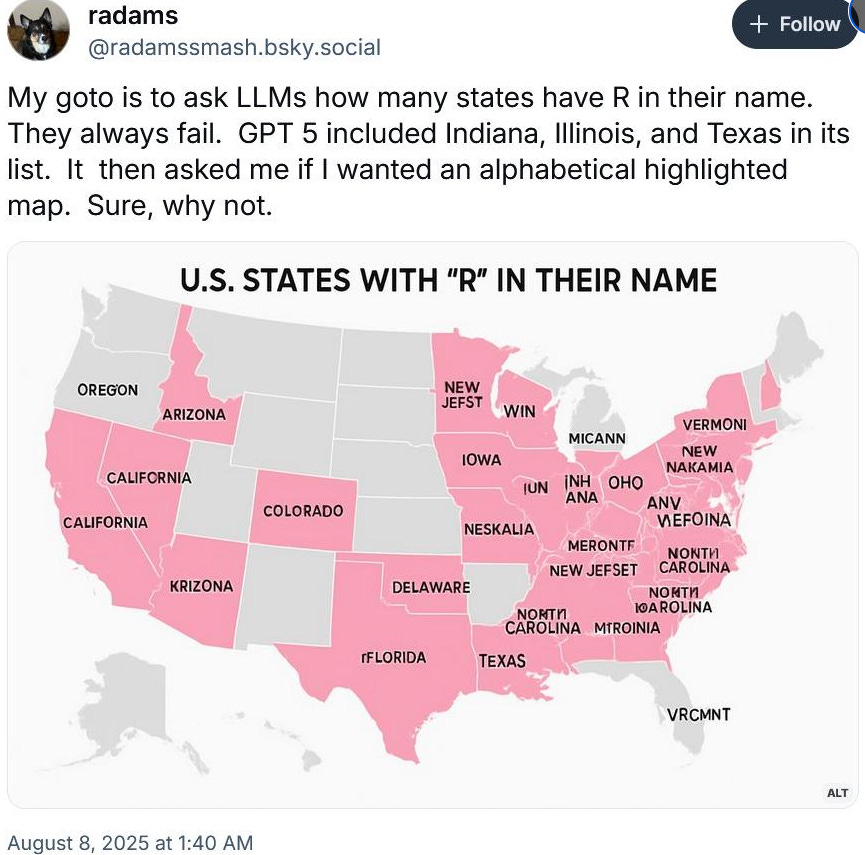
They’re a lot better now, but still struggle with reliability. When I tried it today, the result was almost right, but it still missed North Carolina.
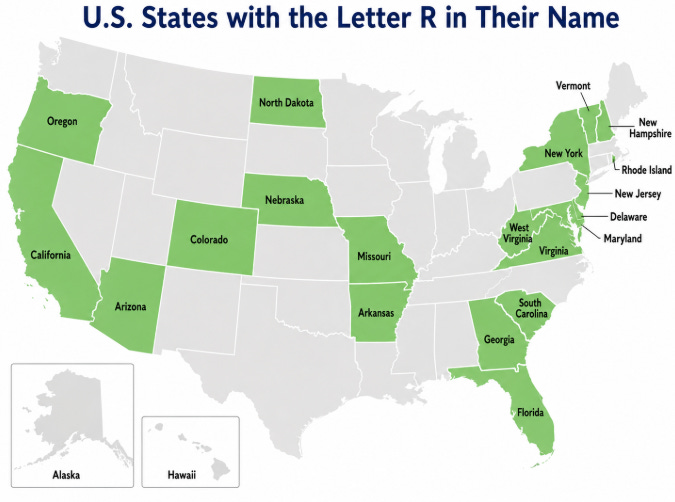
It’s not that AI can’t ever get this right.
Even in the present, there’s a workflow that works much more reliably: run a deterministic program to look up the fifty states, filter for names containing “r,” then generate the map from that verified list.
In this case, however, the system chose an unreliable method. Rather than handling the problem with its strengths, I can see from the chain of thought it went through multiple rounds of guess-and-check only to still come up short.
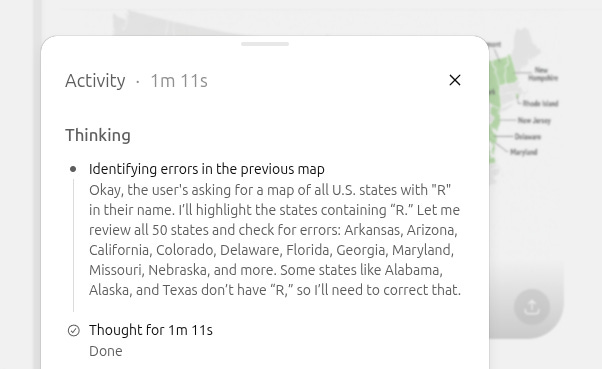
Although it’s gotten better, we still can’t rely on AI for tasks like this yet. Even after it improves again so that it works most of the time, and even with more robust scaffolding, it will still need someone to double-check the final output until we get a few more 9s of reliability.
This is an area of rapid improvement, but there are many areas like this at various capability levels that are all progressing at different rates and the point is, I don’t expect them to all converge to human level in the next few years.
The final nines can be the difference between “nifty” and “useful” and it’s why I expect AI to keep transforming work before it cleanly replaces existing systems. The capability will be there in pieces. The hard part is making the system choose the right tools, check its own work, and know when to call for help.
AI will continue to be superhuman in more and more domains, useful but unreliable in many, and still weirdly fragile in others. The next few years will be a jagged frontier: astonishing successes next to embarrassing failures.
No Takeoff Required
I still expect the coming years to be transformative. AI does not need to become perfectly reliable to make life much better. It only needs to make enough things easier.
Some improvements will be directly AI-driven: faster software, better tutoring, cheaper content creation, more useful search, better medical triage, more capable small teams, faster customer service, more automated compliance, and less paperwork. Others will come from technologies that AI helps accelerate or coordinate: autonomous vehicles, better logistics, drug discovery, personalized medicine, fraud detection, and more public administration capacity.
It won’t be that everything suddenly becomes automated; friction will slowly melt away.
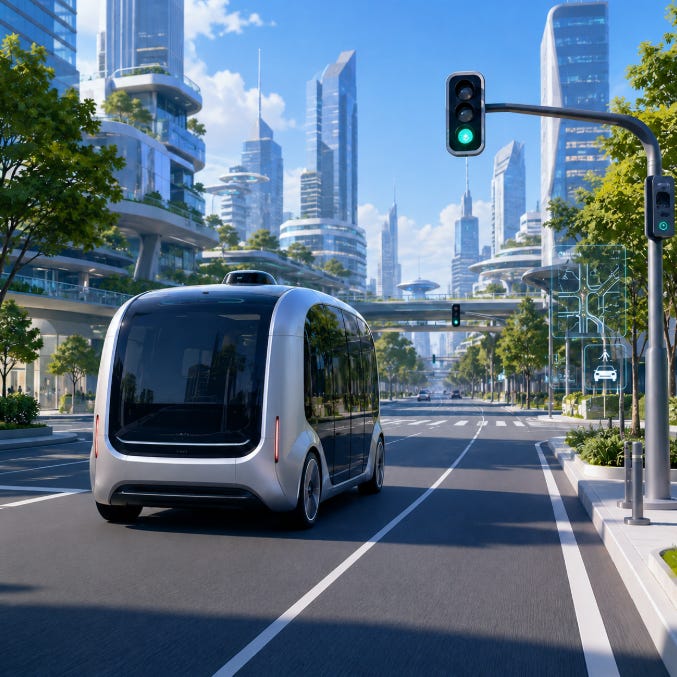
Autonomous transport is the easiest example. It can start city by city and still return time, reduce crashes, expand mobility, and lower costs.
Health is similar. Although not from advanced AI, GLP-1s point to the kinds of improvements that are possible. They’re not just weight-loss drugs. If the category keeps improving, it could help with multiple issues: diabetes, sleep apnea, joint pain, and cardiovascular disease.
GDP may capture some of that through higher labor-force participation and lower downstream medical costs, but the real benefit is mostly uncaptured: people feel better and live longer.
GDP Undercounts Welfare
The internet changed daily life more than GDP suggests.
The late 1990s saw a real productivity acceleration, but the full welfare gain from email, maps, online shopping, digital media, and instant access to information was larger than what showed up in the national accounts.
The coming years may rhyme with that, but more broadly. The internet transformed information, communication, media, and commerce. AI touches those, but also reaches into many more areas like software, medicine, transportation, and research.
Still, there are good reasons not to expect GDP to go vertical.
Humans will remain in the loop longer than the demos suggest. Some capabilities will remain unreliable, and much of the surplus will show up as lower prices, free services, better coordination, time saved, and pain avoided rather than as measured output.
So my take is the actual improvement in daily life will be larger than measured growth implies.
GDP growth has had big swings over the past hundred years, particularly in recovery years, so a single hot year wouldn’t settle anything. To operationalize the actual claim, I propose a bet, open to the first taker: if the annual average of US real GDP growth from 2027 through 2029 exceeds 5%, I’ll read four books of your choosing. If it doesn’t, you read one book of my choice. Resolved per BEA figures as published at the end of September 2030.